
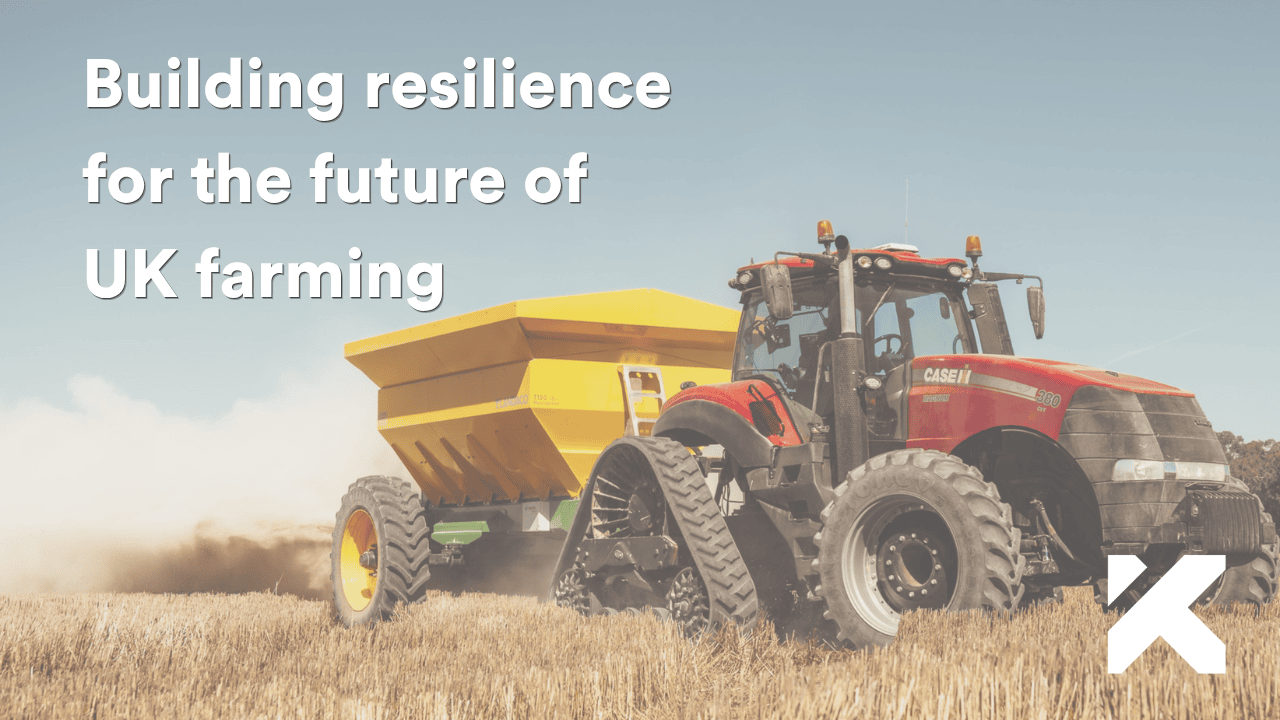
Extreme weather and UK farming have become increasingly linked in recent years. Following another spell of exceptionally hot weather across the UK, the National Farmers’ Union (NFU) has renewed its call for greater investment in water resilience. While rising temperatures often dominate the headlines, the bigger challenge facing UK agriculture is becoming increasingly clear: unpredictability.
When people think about climate change and farming, they often picture hotter summers and dry fields.
The reality is far more complex.
In recent years, UK farmers have faced prolonged periods of drought, record-breaking rainfall, flooding, waterlogged fields and unseasonal weather, often within the space of just a few growing seasons. Planning around the weather has always been part of farming, but many businesses now say the conditions they’re facing are becoming far less predictable. That unpredictability is affecting everything from planting and harvesting to investment decisions and long-term business planning.
A growing challenge for UK agriculture
The latest warning from the NFU comes as much of the UK experiences another spell of unusually high temperatures. The organisation is calling for greater investment in water resilience, highlighting the need for improved water storage, more efficient irrigation systems and better long-term planning to help protect food production. Reliable access to water is becoming increasingly important, not just during heatwaves, but throughout the year as weather patterns become more extreme. The challenge is no longer simply about coping with hotter summers. It’s about preparing for greater variability.
The numbers behind the challenge
The connection between extreme weather and UK farming is becoming increasingly clear. Recent figures demonstrate just how significantly weather volatility is affecting UK agriculture.
- 78% of farmers and growers say they have seen an increase in the frequency of severe weather events over the past 10 years.
- Farm businesses report average financial losses of more than £40,000 as a result of extreme weather.
- The NFU says fields that produce wheat for the nation’s bread can be underwater one year and parched the next, making long-term planning increasingly difficult.
These figures suggest that weather is no longer simply an operational challenge. It is becoming one of the biggest business risks facing many farming enterprises.
Recent harvests tell the story
The impact of extreme weather and UK farming is becoming increasingly visible in harvest results. Following record-breaking rainfall through late 2023 and early 2024, England recorded its second-worst harvest on record. Wheat production fell by 21%, winter barley by 26% and winter oilseed rape by 32% compared with the previous year. Looking beyond a single season, the picture becomes even more concerning.
Analysis by the Energy and Climate Intelligence Unit (ECIU) found that three of England’s five worst harvests on record have now occurred during this decade, highlighting what appears to be a growing pattern of climate-related disruption. The financial consequences have also been significant. Analysis published in 2025 estimated that UK arable farmers faced an £828 million reduction in revenue following one of the worst harvests on record, bringing the cumulative impact of weather-related harvest losses since 2020 to more than £2 billion.
Rather than isolated events, these difficult seasons are beginning to form a pattern, making long-term planning increasingly challenging for farming businesses.
The financial impact
Extreme weather doesn’t just affect crop yields. It affects entire businesses. Reduced production, delayed planting, additional irrigation costs, repairing flood damage and disrupted harvests all place additional pressure on profitability. At the same time, many farmers continue to manage rising fuel, fertiliser, machinery and labour costs. When challenging weather combines with increased operating costs, investment decisions become much more difficult, particularly for businesses already working with tight margins.
Water resilience is becoming a business priority
Water has always been essential to agriculture. Increasingly, however, it is becoming a strategic business issue. The NFU believes improving water resilience through increased investment in reservoirs, on-farm water storage, irrigation infrastructure and water-efficient farming practices will be critical to protecting the UK’s future food production.
As the organisation recently stated, “Food security starts with water.”
Investment in water resilience is no longer simply about responding to drought. It is about helping farming businesses adapt to increasingly unpredictable weather throughout the year.
Adapting through technology
One positive story emerging from these challenges is the increasing adoption of technology. Many farming businesses are investing in precision agriculture, GPS-guided machinery, soil monitoring, smarter irrigation systems and data-driven farming practices to make better use of available resources. As farms become more reliant on increasingly sophisticated machinery and technology, the skills needed to support the industry are evolving too.
“One of the biggest changes we’ve noticed is that employers are now placing much greater emphasis on industry experience. A few years ago, many were happy to consider engineers from outside agriculture if they had transferable skills. While those skills are still important, today’s farming businesses increasingly want engineers who understand the pace, pressures and seasonal demands of the industry from day one.”
Amy Parsons
Client Manager specialising in Agricultural Engineering recruitment, Kemp Recruitment
Amy’s insight reflects a broader shift taking place across the sector. As weather conditions become less predictable and machinery plays an increasingly important role in maintaining productivity, employers have less room for downtime and less time for new recruits to learn the industry from scratch. Agricultural Engineers are no longer simply responsible for repairing machinery. They are becoming a vital part of helping farming businesses maximise productivity, minimise disruption during increasingly narrow harvesting windows and keep operations moving when every day counts. As farms continue to invest in precision agriculture, smarter machinery and water-efficient technologies, the demand for skilled Agricultural Engineers with both technical expertise and sector-specific knowledge is only expected to grow.
Looking ahead
The relationship between extreme weather and UK farming is no longer a future concern. It is already influencing how businesses invest, plan and operate. Whether it is prolonged dry spells, heavier rainfall or increasing pressure on water resources, resilience is becoming one of the defining themes for UK agriculture. While no business can control the weather, farms can invest in the people, infrastructure and technology that help them respond to it.
As extreme weather and UK farming become increasingly intertwined, the businesses that invest in resilience, technology and skilled engineers will be best placed to adapt to whatever the seasons bring next. Whether you’re an agricultural business looking to strengthen your engineering team or an Agricultural Engineer considering your next career move, having the right people in place has never been more important. At Kemp Recruitment, we work with agricultural businesses and skilled engineers across the UK, helping employers find the specialist talent they need and supporting engineers in taking the next step in their careers. If you’d like to find out how we can help, give us a call on 0330 4402323 or click here to view our latest roles.
Sources
National Farmers’ Union (NFU)
NFU urges urgent action on water resilience
https://www.nfuonline.com/news/nfu-urges-action-on-water-resilience/
Energy & Climate Intelligence Unit (ECIU)
England has second worst harvest on record
https://eciu.net/media/press-releases/2025/england-has-second-worst-harvest-on-record-comment
BusinessGreen
Study: UK farmers face £800m hit from one of the worst harvests on record
https://www.businessgreen.com/news/4522784/study-uk-farmers-800m-hit-worst-harvests-record
The Guardian
Harvest in England the second worst on record because of wet weather
https://www.theguardian.com/environment/2024/oct/10/harvest-in-england-the-second-worst-on-record-because-of-wet-weather


